
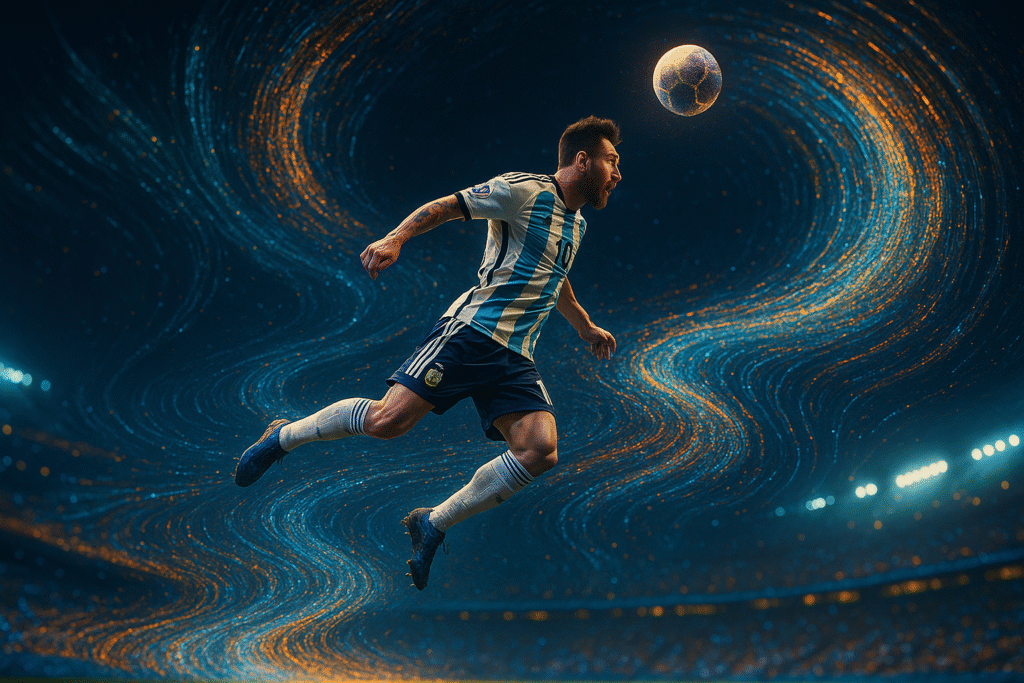
One of Lionel Messi’s most memorable goals has been turned into something far beyond a highlight reel. In 2025, Messi collaborated with media artist Refik Anadol on Living Memory: Messi – A Goal in Life, an immersive digital artwork built around the header Messi scored against Manchester United in the 2009 UEFA Champions League final — the goal he selected as the most meaningful of his career.
The work ultimately raised $1.87 million through an online auction at Christie’s. According to Christie’s official results, proceeds were directed to multiple nonprofits, including education programs supported through the Inter Miami CF Foundation’s partnership with UNICEF.
The Goal Behind the Artwork
The project centers on Messi’s famous second-half header in Barcelona’s 2009 Champions League final victory over Manchester United. Christie’s described it as the goal Messi personally chose as the most meaningful of his career. The work was exhibited publicly at Christie’s Rockefeller Center in New York before the auction closed on July 22, 2025. Christie’s exhibition announcement provides the timeline and project details.
How AI Was Actually Used
This was not simply an AI-generated picture of Messi. Anadol’s studio describes the piece as an eight-minute immersive experience combining motion tracking, biometric information and data-driven artificial intelligence. Seventeen points on Messi’s body were mapped to reconstruct movement, while voice, breathing and heartbeat data contributed to the soundscape. Refik Anadol Studio’s project page explains the process in detail.
That distinction matters. The story is less about a machine replacing an artist and more about a high-profile artist using AI and data as materials to reinterpret a human memory.
What Did the Auction Actually Sell For?
Christie’s records the sale total at $1,865,000, commonly rounded to $1.87 million. The auction house says the work was offered as a single-lot online sale running from July 8 to July 22, 2025. The official Christie’s auction page records the result.
The Art Newspaper also reported the $1.87 million result, describing the work as an AI-powered data sculpture and noting its charitable purpose. That independent coverage provides useful context beyond the auction house’s own announcement. Read The Art Newspaper’s report.
Why This Story Matters Beyond Messi
Celebrity memorabilia traditionally preserves physical objects: shirts, boots, signed photographs and match-used equipment. This project points toward another possibility — preserving the experience of a sporting moment through data, sound, movement and immersive media.
That does not mean every famous goal will become a million-dollar AI artwork. Messi’s global profile, Anadol’s reputation, Christie’s involvement and the charitable structure made this an unusually high-profile collaboration. But it demonstrates how sports history can be packaged and experienced in new forms.
AI as a Tool, Not the Whole Story
The most interesting question may not be whether AI can make art. It is whether technology can change the way people remember events that already carry enormous emotional value. In this case, the underlying asset was not merely data — it was a shared football memory recognized by millions of people.
Anadol’s project transformed that memory into an environment built from movement and biometric information. The technology supplied a new visual language, but Messi’s history supplied the meaning.
The Bigger Trend to Watch
Sports organizations, athletes, museums and artists are increasingly experimenting with immersive installations, digital collectibles and data-driven storytelling. The lasting significance of A Goal in Life will depend less on its auction price than on whether projects like it become a durable way of preserving sporting history rather than a novelty tied to the AI boom.
For now, the Christie’s sale provides a striking case study: one header scored in Rome in 2009 was reconstructed with modern AI, exhibited in New York and turned into a $1.87 million charitable artwork sixteen years later.