
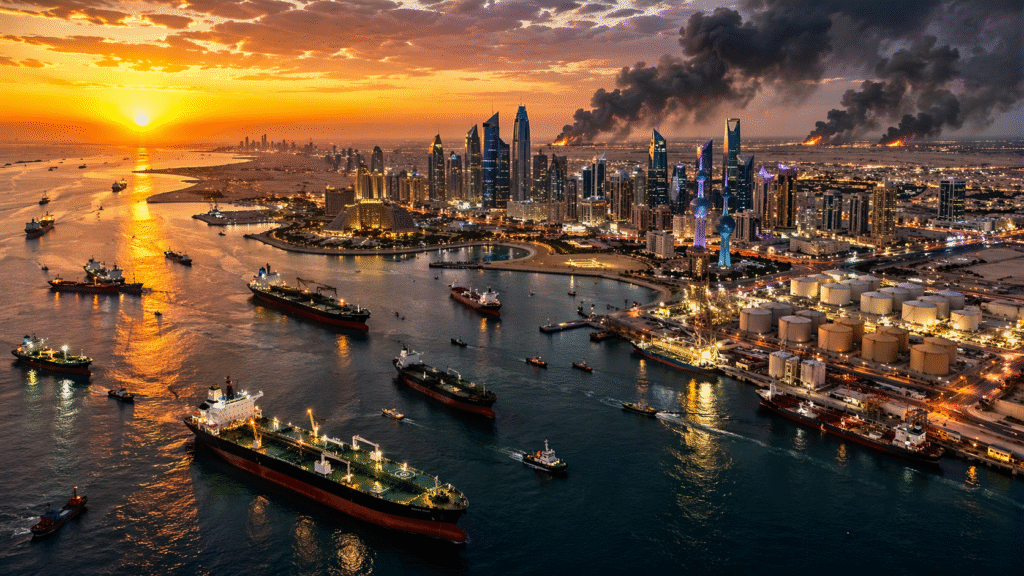
The Iran war is imposing real economic costs across Arab countries, but there is no credible single number that captures the region’s total losses. The impact differs dramatically between oil exporters, tourism economies, transport hubs and countries dependent on imported energy.
That distinction matters. Higher oil prices can increase revenue for some producers while the same price shock raises transport, food and electricity costs elsewhere. Meanwhile, attacks on infrastructure and disruption around the Strait of Hormuz and Red Sea can hurt even countries benefiting from expensive crude.
Energy Wealth Does Not Eliminate Energy Risk
The latest escalation illustrates the contradiction. Saudi Arabia’s East-West pipeline — a strategic route designed to move crude toward the Red Sea while bypassing the Strait of Hormuz — was shut after an attack in September. The Associated Press reported that the route had been carrying roughly 2.6 million to 4 million barrels a day.
For Gulf producers, high crude prices can strengthen export revenue. But damaged infrastructure, constrained shipping routes, higher insurance costs and uncertainty over future attacks can reduce those gains and complicate long-term investment.
Shipping Disruption Spreads the Cost
The Strait of Hormuz and Bab el-Mandeb are not simply regional waterways. They connect Gulf energy exports and Asian-European trade to global markets. Disruption can force vessels to wait, reroute or pay higher insurance premiums, costs that eventually move through supply chains.
AP reported in September that oil prices had moved above $100 a barrel amid continuing conflict and disruption. That matters for Arab countries that import fuel as well as for households and businesses worldwide.
Aviation, Tourism and Investment Face a Different Shock
Airlines and tourism businesses are particularly sensitive to regional instability. Conflict can trigger airspace restrictions, longer flight paths, cancellations and higher fuel and insurance costs. Even destinations far from active fighting can suffer when travelers perceive the wider region as risky.
Investment is harder to measure but potentially more consequential. Large infrastructure, tourism and diversification projects depend on predictable financing and confidence. Persistent regional conflict raises the risk premium investors attach to future projects.
Why There Is No Responsible ‘Total Loss’ Number Yet
The original version of this article referred broadly to billions of dollars in missed opportunities. That kind of statement sounds precise without providing a defensible calculation. A professional assessment should separate direct physical damage, lost output, government spending, tourism losses, shipping costs and foregone investment rather than pretending they can already be reduced to one verified total.
The eventual economic bill will also depend heavily on duration. A short disruption followed by restored shipping produces a very different outcome from months of attacks on energy infrastructure and trade routes.
Different Arab Economies Face Different Risks
- Gulf oil exporters can benefit from higher crude prices while simultaneously facing infrastructure, shipping and investment risks.
- Egypt and other trade-dependent economies are vulnerable to disruptions in shipping, tourism and imported energy costs.
- Jordan, Lebanon and other energy importers can feel higher fuel and transport costs without receiving the export windfall enjoyed by producers.
- Regional aviation and logistics hubs face rerouting costs and uncertainty whenever airspace or maritime corridors become unsafe.
What Happens Next?
The most important variable is not today’s oil price. It is whether the conflict expands, stabilizes or moves toward a durable political settlement. Continued attacks on alternative oil routes would make the economic consequences much more serious. A sustained reopening of shipping lanes would reduce pressure even before the underlying political conflict is resolved.
The defensible conclusion is therefore not that Arab countries have lost a specific number of billions. It is that the war is redistributing wealth and risk across the region while making trade, energy and investment more expensive and less predictable. The longer that uncertainty lasts, the larger the eventual economic cost is likely to become.