
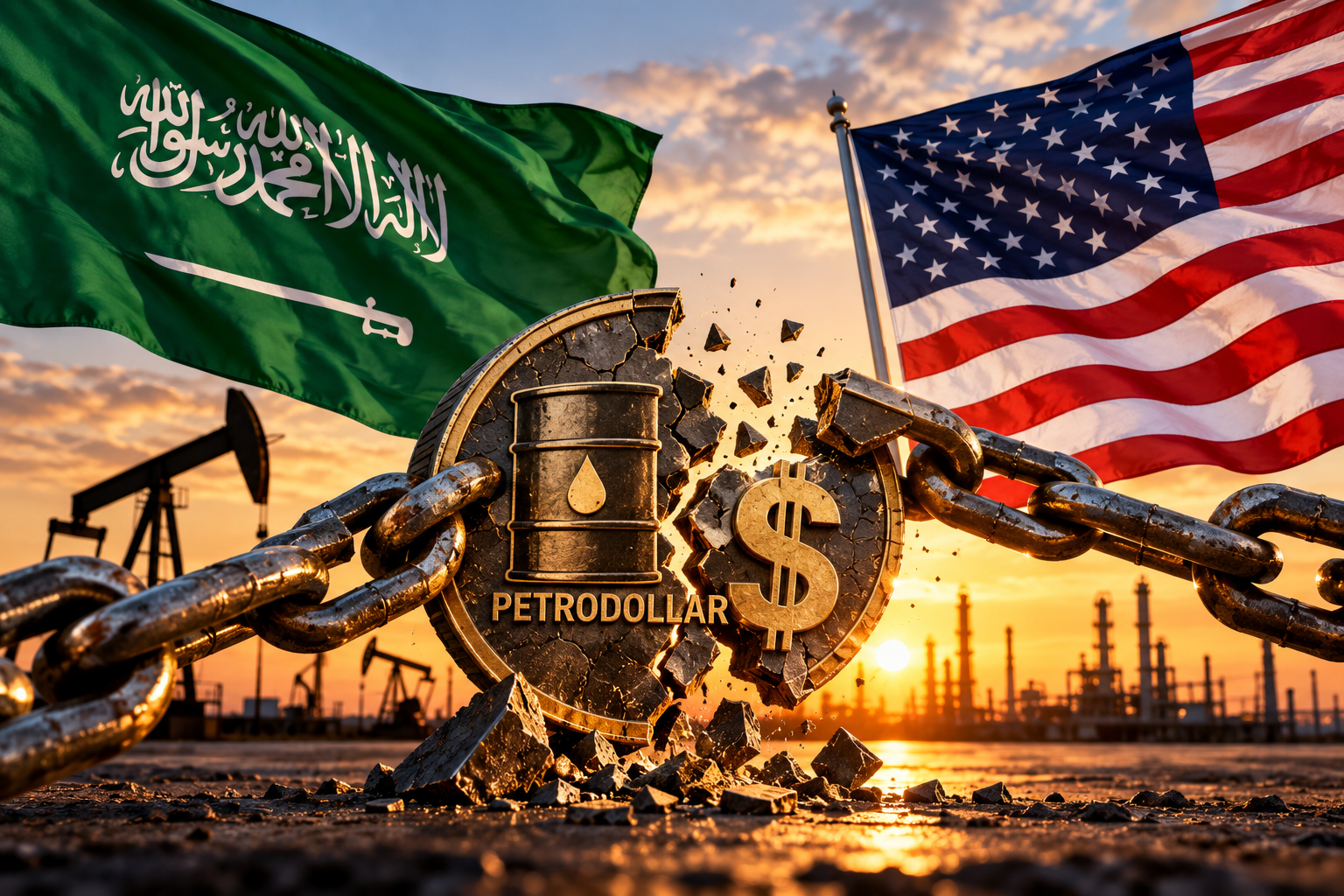
For decades, Saudi oil, American security and the U.S. dollar have been linked in one of the most important relationships in the global economy. Now renewed fighting around Yemen and Washington’s reluctance to intervene directly against the Houthis are reviving a provocative question: could Riyadh eventually give other currencies a larger role in its oil trade?
There is no public evidence that Saudi Arabia has decided to abandon the dollar, and no evidence that it has tied oil-payment policy to President Donald Trump’s refusal so far to provide the direct military intervention Riyadh sought against the Houthis. In fact, several recent developments point to Saudi caution rather than an imminent monetary break with Washington.
But the broader question is legitimate. Saudi Arabia is deepening ties with China and other Asian economies, new payment systems are developing, and the kingdom is pursuing a more diversified foreign policy. If Riyadh wanted greater financial flexibility without destabilizing its own economy, it has several options.
What changed in Yemen?
The immediate issue is security, not currency.
Reuters reported on September 11 that Saudi Crown Prince Mohammed bin Salman sought U.S. military assistance against Yemen’s Iran-aligned Houthis. Three sources told Reuters that Washington offered intelligence support rather than direct military intervention.
The pressure continued. Reuters reported on September 21 that the United States had so far rebuffed repeated Saudi pleas to join the fight. Reuters said it could not independently verify a New York Times report that Trump had initially prepared strikes and then called them off at the last minute.
The security stakes are substantial. Houthi advances have increased pressure around the Bab el-Mandeb, the entrance to the Red Sea and a critical trade route. Saudi Arabia’s East-West oil pipeline has also faced disruption during the wider regional conflict. Reuters reported on September 22 that Saudi Arabia restarted the pipeline at a reduced rate after a September 11 drone attack damaged three pumping stations. Riyadh blamed that attack on Iraqi militia groups, not the Houthis.
Meanwhile, Saudi Arabia has looked beyond Washington for diplomatic help. Reuters reported that China privately asked Iran to help rein in the Houthis after Saudi Arabia appealed to Beijing.
That does not mean Riyadh is replacing the United States with China. It does show why Saudi leaders increasingly value having several powerful relationships at the same time.
First, the petrodollar myth
Discussion of the “end of the petrodollar” often begins with a misleading idea: that a single formal agreement forces Saudi Arabia to sell all of its oil exclusively in U.S. dollars.
The petrodollar is better understood as a system that developed over decades. International oil has traditionally been priced and settled overwhelmingly in dollars, oil exporters accumulate dollar revenues, and substantial portions of those revenues flow into dollar-denominated assets and financial markets.
Saudi Arabia became one of the central players in that system, but there is no switch that Riyadh can simply turn off to “cancel” the petrodollar.
The more useful question is whether Saudi Arabia could gradually allow a greater share of its international trade, including selected energy transactions, to be settled in other currencies.
Option 1: Accept yuan for some Chinese oil purchases
The most discussed alternative is the Chinese renminbi, or yuan.
China is a major buyer of Saudi crude, and Beijing has long sought a larger international role for its currency. Riyadh could theoretically allow selected Chinese customers to settle some transactions in yuan while continuing to conduct most oil trade in dollars.
That would be diversification, not abandonment of the dollar.
There are significant obstacles. S&P Global has examined the possibility and concluded that meaningful yuan-based Saudi oil trade faces substantial challenges. Saudi Arabia runs a large trade surplus with China, meaning it could accumulate more yuan than it can easily spend. The currency is also less widely used in international finance, while hedging and investment options are more limited than for the dollar.
A limited arrangement is easier to imagine. Saudi Arabia could use yuan proceeds to pay for Chinese engineering, technology, construction or other imports, or invest some proceeds in Chinese assets and projects. S&P Global notes that deeper bilateral economic ties could gradually create more outlets for those yuan revenues.
Option 2: Use several currencies instead of choosing one
Saudi Arabia does not necessarily have to choose between the dollar and the yuan.
A multi-currency model could preserve the dollar as the dominant settlement currency while allowing some transactions in yuan, euros or the currencies of major trading partners where commercially practical.
This would reduce concentration without requiring a dramatic break with the U.S.-centered financial system. It would also fit Saudi Arabia’s broader strategy of maintaining important relationships with Washington, Beijing and other major capitals simultaneously.
The effect on the dollar would initially be small. But if large commodity exporters increasingly accepted several currencies over many years, the dollar’s near-universal role in energy settlement could gradually become less absolute.
Option 3: Expand local-currency trade outside oil first
A less disruptive path would be to leave most crude sales in dollars while expanding local-currency settlement for non-oil trade.
Saudi companies could conduct more business with major partners without converting every transaction through dollars. Riyadh could gain experience with alternative settlement mechanisms without experimenting with the kingdom’s most important export market.
This could be a more practical route to diversification than announcing a politically charged change to oil pricing.
Option 4: Continue experimenting with new payment technology
Central banks are exploring faster cross-border payment systems, central-bank digital currencies and other mechanisms that could reduce dependence on traditional correspondent banking.
Saudi Arabia explored this area through mBridge, a cross-border central-bank digital-currency project associated with China, Hong Kong, Thailand, the United Arab Emirates and other participants.
But a major recent development cuts against the idea that Riyadh is rushing into a China-led alternative to the dollar. The Financial Times reported this month that Saudi Arabia has withdrawn from mBridge. The Saudi Central Bank said its participation was part of a planned proof of concept that concluded in May 2025.
That is an important counterweight to claims that Saudi Arabia is preparing an immediate break from the dollar. Riyadh can continue studying digital payments without committing itself to a particular geopolitical payment bloc.
Option 5: Keep the dollar while strengthening alternatives
The most conservative option may also be the most realistic: change very little in oil settlement while expanding Saudi Arabia’s strategic choices elsewhere.
Saudi Arabia can maintain dollar oil sales and its close economic relationship with the United States while simultaneously increasing trade, investment and diplomatic cooperation with China, India, Europe and other partners.
In that scenario, alternatives matter even if Riyadh rarely uses them. Greater economic optionality can give Saudi policymakers more room to maneuver without the financial disruption that would accompany a sudden currency shift.
Why Riyadh would be extremely careful
The biggest reason is not Washington. It is Saudi Arabia’s own monetary system.
The Saudi riyal is pegged to the U.S. dollar. In its 2026 Article IV consultation, the International Monetary Fund said the dollar peg remains appropriate. Saudi authorities reaffirmed their commitment to it.
The peg provides a monetary anchor and supports financial stability. A major shift in the currency composition of Saudi oil revenues would therefore have to be managed alongside a domestic monetary system still closely tied to the dollar.
Saudi Arabia also holds extensive economic, investment and security relationships with the United States. Those connections create strong incentives for gradual diversification rather than an abrupt rupture.
China is becoming more important, but that does not automatically mean the yuan
China’s role in the Gulf is clearly expanding. Its importance as an energy customer gives Beijing a major interest in stable Saudi exports, while Riyadh increasingly sees China as an economic and diplomatic partner.
The recent Saudi appeal for Chinese help with Iran and the Houthis demonstrates that growing role.
But diplomatic influence, trade volume and currency dominance are different things.
The dollar benefits from deep and liquid financial markets, broad convertibility and a global financial infrastructure built over decades. The yuan does not yet offer the same combination of features internationally.
Saudi Arabia can therefore become economically closer to China without replacing the dollar with the yuan.
So, is the petrodollar era ending?
There is no evidence that Saudi Arabia is about to abandon the dollar because Trump declined to provide the direct military intervention Riyadh sought against the Houthis.
Recent evidence actually points toward caution. The kingdom remains committed to its dollar peg, and Saudi Arabia has withdrawn from the mBridge project that was often cited as evidence of a coming alternative payment architecture.
But the strategic environment around Riyadh is changing. China is a crucial customer. Saudi foreign policy is becoming more diversified. New payment technologies are developing, and countries around the world are experimenting with direct local-currency trade.
If Saudi leaders become less confident that their traditional security relationships will always produce the support they expect, that could add to the incentives for broader economic diversification. It does not prove that a currency shift will follow.
The more plausible long-term scenario is therefore not a dramatic announcement declaring the death of the petrodollar. It is incremental change: selected transactions in yuan or other currencies, more bilateral trade settled directly, broader foreign investment and new payment channels operating alongside the dollar.
The dollar could remain dominant throughout that process.
But if those alternatives grow large enough over time, historians may eventually conclude that the petrodollar did not end on a particular day. It simply became one option among several.
This article is an analysis of publicly available reporting and economic research. It does not claim that Saudi Arabia has announced a change to its oil-payment policy.