
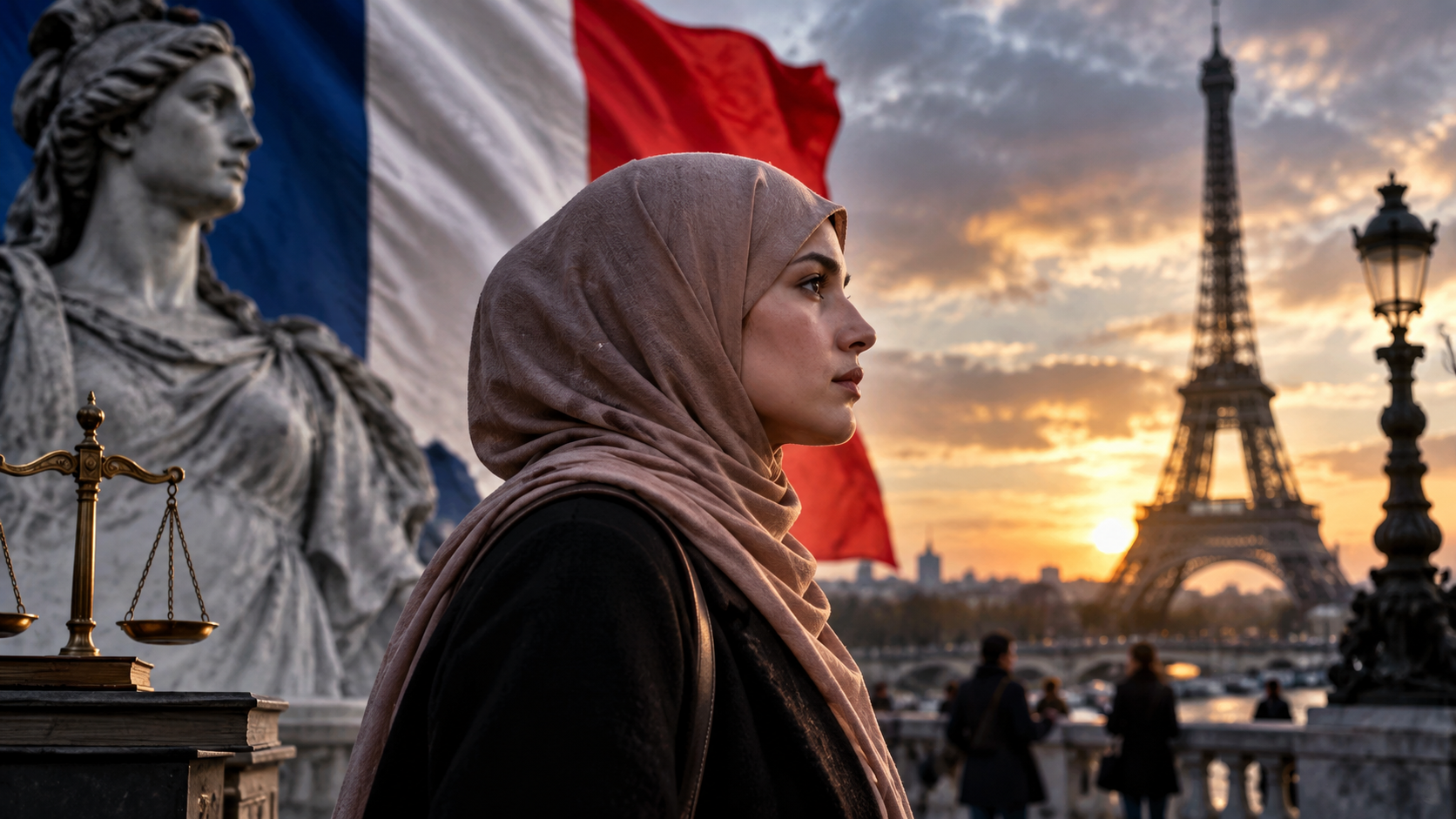
France is once again confronting one of Europe’s most divisive questions: how far should a secular state be allowed to go in regulating religious clothing?
The debate has returned ahead of the 2027 presidential election after France’s National Rally renewed its long-standing proposal to prohibit Islamic headscarves in public spaces. Le Monde reports that the proposal has also exposed disagreements and uncertainty inside the party over what exactly would be prohibited and how such a measure could be enforced.
A Question Bigger Than the Hijab
The controversy raises an uncomfortable question for liberal democracies: if a woman freely chooses to wear a hijab, should the government have the authority to tell her to remove it simply because she enters a public space?
Supporters of stricter restrictions argue that France’s tradition of laïcité — its particular model of secularism — requires a firm separation between religion and public institutions. Some also argue that certain religious symbols can represent political or social pressure rather than purely personal faith.
Opponents answer that secularism should restrain the state, not ordinary citizens. They argue that banning a woman from wearing a headscarf while walking down a street, shopping or using public space would transform a principle intended to protect freedom of conscience into a restriction on individual religious expression.
What France Already Bans — And What It Does Not
The distinction matters. France already has significant restrictions involving religious dress. Public employees are subject to religious-neutrality requirements while carrying out their duties, and students in public primary and secondary schools have been prohibited since 2004 from wearing conspicuous religious symbols, including Islamic headscarves. Recent reporting on the controversy has summarized those existing restrictions while noting that the new National Rally proposal would go considerably further by targeting headscarves in public spaces more broadly. Read the background here.
The renewed proposal has prompted a social-media solidarity campaign in which women have posted images wearing head coverings in opposition to the proposed ban. The campaign was reported in early September.
The Political Problem
The National Rally itself appears to be wrestling with the proposal. Marine Le Pen has continued to support putting the issue before voters through a referendum, while Jordan Bardella has taken a more cautious position. Le Monde reported that Bardella has emphasized a narrower approach involving conspicuous religious symbols in public buildings.
That disagreement points to the practical difficulty hidden beneath the political slogan. What qualifies as a prohibited head covering? Would restrictions apply only to Muslim clothing or to visible symbols associated with other religions as well? How would police enforce such a rule without creating unequal treatment?
Women’s Rights — But Whose Choice?
There is also a contradiction at the heart of the debate. Advocates of a ban sometimes present it as a defense of women against religious or social coercion. But critics ask whether forcing a woman to remove clothing she personally chooses is itself another form of coercion.
Both concerns can exist at once. A democratic society can oppose forced religious dress while also opposing forced removal of religious dress. The harder question is whether the state can reliably distinguish between coercion and personal conviction without stripping individuals of agency.
Europe Is Watching
France’s argument is about more than one garment. It touches immigration, integration, religion, national identity, women’s autonomy and the meaning of secular government. Those issues are increasingly shaping politics across Europe.
And that is why the controversy will not disappear even if this particular proposal fails. France is effectively debating where collective national identity ends and individual liberty begins.
The question for readers is simple but difficult: should a democratic government ever be able to tell an adult woman that a religious garment she freely chooses to wear is forbidden in ordinary public life?
Top New Trends welcomes respectful debate. Criticism of policies, political parties and ideas should never become hostility toward people because of their religion or background.