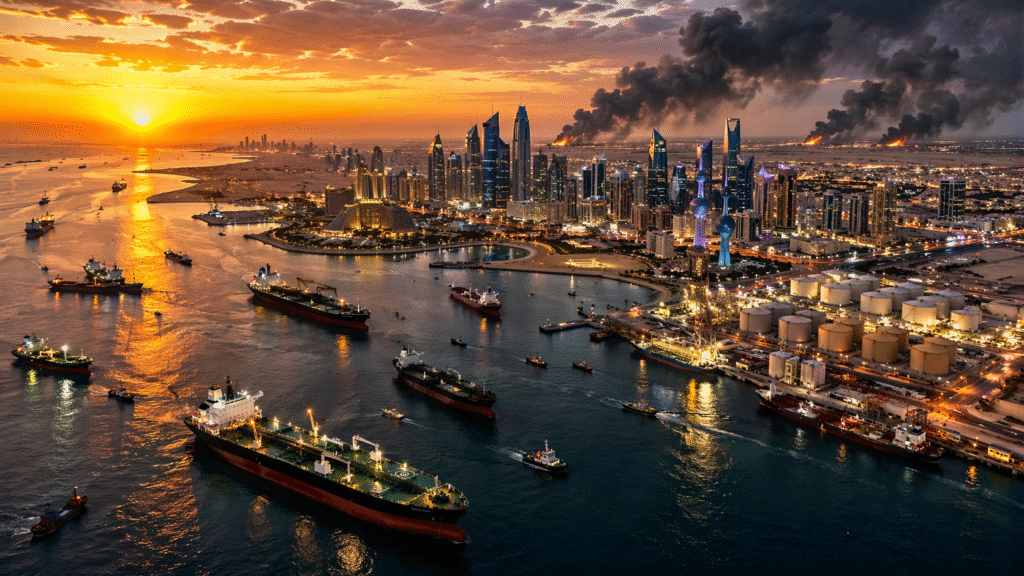
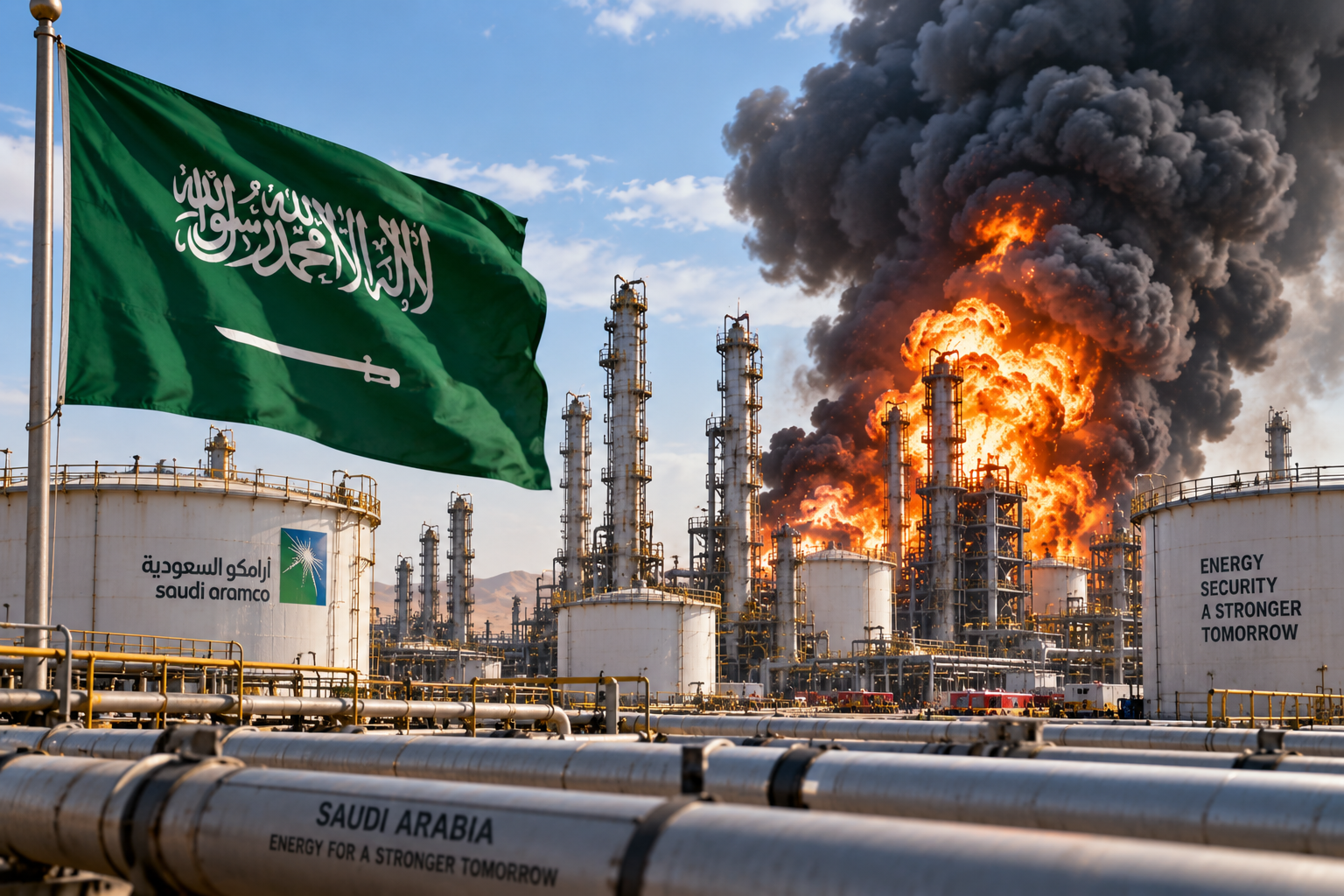
A drone strike has crippled one of Saudi Arabia’s most important oil export routes just as pressure builds around two of the world’s most consequential maritime chokepoints. The effects are already reaching global energy markets.
For millions of people thousands of kilometres from Saudi Arabia, the East-West Pipeline is infrastructure they may never have heard of. Yet what happens to it can influence fuel prices, shipping costs, inflation and household budgets far beyond the Middle East.
Saudi Arabia shut its crucial East-West oil pipeline after a drone attack. The roughly 1,200-kilometre system carries crude from the kingdom’s oil-producing east to the Red Sea port of Yanbu, providing an alternative to exports through the Strait of Hormuz. Reuters reported on September 14 that the outage threatens flows equivalent to as much as 4% of global oil supply if the route cannot be restored quickly.
Why the East-West Pipeline Matters
The Strait of Hormuz is one of the world’s most important energy corridors. When shipping through the strait becomes dangerous or constrained, Saudi Arabia’s cross-country pipeline offers a strategic alternative: crude can move overland to Yanbu and reach the Red Sea without first passing through Hormuz.
That redundancy is exactly why the latest damage matters. The Associated Press reported, citing two regional officials, that much of the pipeline could remain out of service for three to five weeks while repairs are carried out, including work at a major pumping facility.
The question is therefore not simply whether Saudi Arabia has oil available. It is whether that oil can be moved to customers quickly, safely and economically while several transport routes face simultaneous pressure.
Oil Above $107 as Markets Price In the Risk
Energy markets are already reacting. Reuters reported Monday that Brent crude had risen about 3% to $107.81 a barrel, while U.S. crude climbed to $102.94.
Those moves matter beyond trading desks. Sustained increases in crude prices can feed into gasoline and diesel, aviation fuel, freight costs and the price of moving goods. If higher energy costs persist, they can also add to inflationary pressure and complicate decisions for central banks.
A damaged pipeline in the Saudi desert can therefore become a transportation problem in Europe, a manufacturing problem in Asia or a household-budget problem in North America.
The Pipeline Is Only One Part of the Danger
The deeper concern is that the East-West Pipeline disruption is occurring alongside instability around two strategic waterways.
To the east lies the Strait of Hormuz, the traditional gateway for much of the Gulf’s energy exports. To the west and south lies Bab el-Mandeb, connecting the Red Sea with the Gulf of Aden and the Indian Ocean.
Yemen’s Iran-backed Houthi forces have expanded their position along the Red Sea. AP reported on September 14 that the Houthis seized the strategic Greater and Lesser Hanish islands, strengthening their position around a key maritime shipping route.
This does not mean all Red Sea shipping has stopped. It does mean the security calculation for shipowners, insurers and energy traders has become more complicated.
Three Pressure Points, One Global Problem
Seen together, the geography explains why markets are nervous. Hormuz is a crucial Gulf exit. The East-West Pipeline is Saudi Arabia’s land-based alternative. Bab el-Mandeb is a critical gateway for traffic moving between the Red Sea and the Indian Ocean.
Pressure on one route can often be absorbed through inventories, rerouting and spare logistical capacity. Pressure on several at the same time is harder — and usually more expensive — to manage.
Saudi storage at Yanbu can provide a temporary buffer. Reuters reported, citing industry sources, that available stocks there could cover roughly five to seven days of exports at recent levels. That buys time, but it does not eliminate the need to restore reliable flows.
Diplomacy Has Hit Another Obstacle
There had been hope that regional diplomacy could reduce uncertainty around Hormuz. But a planned meeting in Oman involving Iran and Gulf countries was postponed. Reuters reported that the talks were intended to discuss potential arrangements concerning the strategic strait; no new date was announced at the time.
The postponement does not mean diplomacy has failed. But at a moment when energy markets are searching for evidence of de-escalation, it adds another layer of uncertainty.
Who Attacked the Pipeline?
This is an area where careful attribution matters. Saudi authorities said the drones came from Iraqi territory and blamed Iran-backed militias in Iraq. Iran has denied responsibility, while U.S. President Donald Trump has said he believes Iran was probably responsible. The publicly available reporting does not justify presenting direct Iranian responsibility as an independently established fact.
The Houthi advances in Yemen are a separate development and should not be conflated with the attribution surrounding the East-West Pipeline attack.
What Happens Next
The immediate question is how quickly Saudi Arabia can restore meaningful pipeline capacity. A faster-than-feared restart could ease some supply anxiety. A prolonged outage, combined with continued disruption around Hormuz and growing insecurity near Bab el-Mandeb, would keep pressure on shipping and energy markets.
Oil markets do not need the world to literally run out of crude for prices to rise. Traders and refiners only need to believe future barrels will be harder, slower or more expensive to obtain.
A Warning About the World’s Energy Arteries
Modern economies can feel remarkably resilient. Oil crosses continents, ships arrive on schedule, aircraft fly and factories receive components from the other side of the world. Because these systems usually work, it is easy to overlook how much depends on a relatively small number of pipelines, ports and narrow waterways.
The Strait of Hormuz is one. Bab el-Mandeb is another. Saudi Arabia’s East-West Pipeline was built in part to provide an alternative when the Gulf route became vulnerable.
Now that alternative itself is damaged.
That is why this story extends far beyond Riyadh, Tehran or Washington. If the arteries carrying global energy remain constrained, the economic consequences will not remain in the Middle East. Consumers around the world could ultimately help pay the price.
Top New Trends is following this developing story. Figures and conditions may change as pipeline repairs, shipping movements and diplomatic efforts evolve.