A false claim that presidential candidate Flávio Bolsonaro intends to strip Our Lady of Aparecida of her title as Brazil’s patron saint has raced through social media days before the October 4 election—turning a revered religious symbol into a test of misinformation, judicial power and the country’s changing Christian identity.
The central allegation is unsupported. Bolsonaro has not said he would remove the title, and Brazil’s president does not have the authority to revoke a papal designation. The Catholic Church’s title dates to a 1930 decree by Pope Pius XI; the Brazilian state later recognized it.
Yet the rumor has become one of the closing campaign’s most emotionally powerful controversies. It has drawn responses from President Luiz Inácio Lula da Silva, Bolsonaro, the national bishops’ conference and Brazil’s highest electoral court. It has also generated additional falsehoods, including recycled footage presented as evidence of an election-related attack on a statue.
The dispute matters beyond Sunday’s vote. It shows how misinformation succeeds when it attaches an invented claim to a real cultural anxiety: Brazil remains the world’s largest Catholic country, but Evangelical churches have expanded dramatically and become an increasingly organized political force.
What Bolsonaro actually said
In an August 23 campaign video, Sen. Flávio Bolsonaro, the Evangelical son of former President Jair Bolsonaro and Lula’s principal challenger, said he would symbolically declare that Brazil belongs to Jesus Christ.
Some Catholics interpreted the statement as implying that a Bolsonaro government would displace Our Lady of Aparecida. Lula supporters and other accounts amplified that interpretation until it hardened into a purported plan.
But The Associated Press found no statement from Bolsonaro supporting the saint’s removal. He has described the claim as the campaign’s largest piece of fake news and said his words referred to a symbolic prayer.
The comment can legitimately be debated. Declaring a religiously diverse republic to “belong” to Jesus raises questions about pluralism, political theology and the message sent to non-Christians. But criticism of what Bolsonaro said is different from attributing to him a policy he did not announce.
An old bill gave a new rumor a surface of plausibility
The story did not emerge from nothing. In 2007, then-lawmaker Victório Galli—who later became an ally and adviser to Jair Bolsonaro’s government—introduced a bill seeking to narrow the patroness designation to Roman Catholic Brazilians. The proposal was shelved the following year.
That history supplied a factual fragment that could be detached from its context. Projeto Comprova’s review found that Flávio Bolsonaro was not the bill’s author and has not endorsed it. A past proposal from a political ally is relevant background, but it is not evidence of the candidate’s present intention.
The legal reality is even more limiting. Vatican records explain that Pope Pius XI declared Our Lady of Aparecida Patroness of Brazil in 1930. A Brazilian president cannot simply cancel that ecclesiastical title by executive decision.
Why the claim spread so quickly
A rumor becomes politically potent when voters are already worried that its underlying scenario could someday be true.
Brazil’s 2022 census found that 56.7% of people aged 10 and older identified as Roman Catholic and 26.9% as Evangelical. Catholics remain the majority, but the Evangelical share has nearly tripled from 9% in 1991. The religiously unaffiliated have grown as well.
The shift is social, cultural and political. Evangelical churches—especially Pentecostal and neo-Pentecostal communities—have expanded through neighborhoods, broadcast media and digital networks. Evangelical legislators and pastors have become influential in debates over abortion, sexuality, education and family policy.
That growth does not mean Evangelicals as a group want Catholic symbols removed, nor that Catholic and Evangelical identities map cleanly onto opposing parties. Millions of believers cross political lines. But changing demographics can produce a sense of cultural loss among members of a formerly dominant tradition.
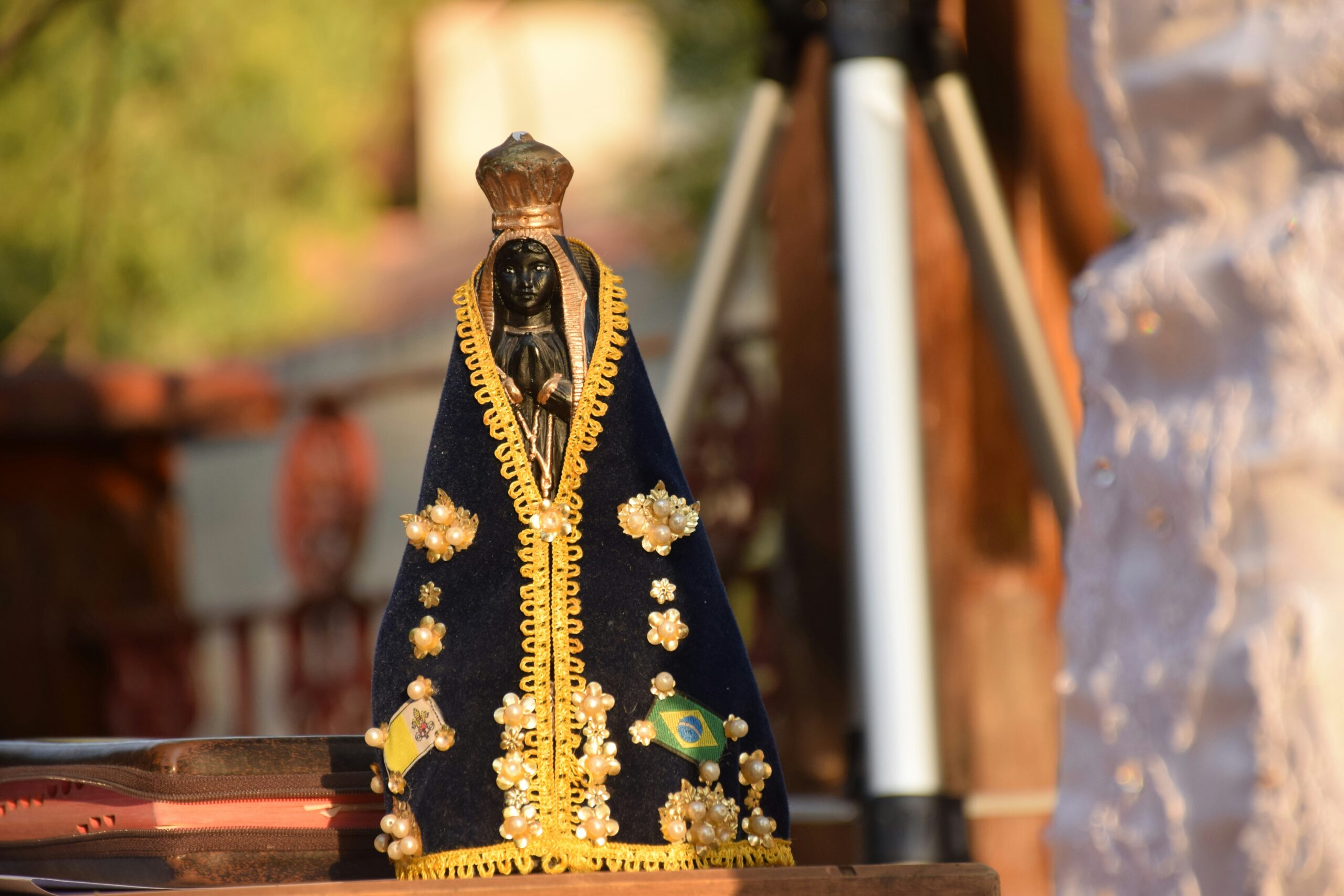
Our Lady of Aparecida is particularly powerful terrain. The small dark-colored statue, associated with a story of fishermen finding it in the Paraíba River in the early 18th century, carries religious, racial and national meaning. Her October 12 feast is a national holiday, and the basilica at Aparecida is a major pilgrimage destination.
The false claim therefore touched something larger than institutional Catholicism: a fear that an emblem woven into Brazilian identity could become collateral damage in an Evangelical political ascent.
Both campaigns found political value in the dispute
Lula, who is Catholic, told supporters that no one would mock Our Lady of Aparecida while he remained president. The statement did not directly repeat that Bolsonaro had a removal plan, but it kept the threat at the center of campaign discussion and allowed Lula to present himself as defender of the symbol.
Bolsonaro, meanwhile, accused people inside the National Conference of Bishops of Brazil, known as the CNBB, of helping Lula’s Workers’ Party spread the story. He did not publicly provide evidence for that allegation. The CNBB denied producing, authorizing or distributing false election material and responded that one falsehood cannot be fought with another.
The episode demonstrates how misinformation creates secondary accusations that can survive even after the original claim is debunked. The debate shifts from whether the story is true to who supposedly invented it, which institutions are partisan and which side is being persecuted.
The courts entered a difficult free-speech fight
Bolsonaro’s campaign asked electoral authorities to order removal of posts asserting that he planned to demote the saint. Justice André Mendonça initially directed platforms to remove publications presenting the allegation as fact. Conflicting interventions from other senior justices followed before the Superior Electoral Court considered the matter.
On September 30, the electoral court maintained an order targeting posts that falsely attributed the plan to Bolsonaro, while judges debated how narrowly the restriction should be drawn and whether satire or broader criticism should remain protected.
The court faces a genuine dilemma. False statements presented as verified news can distort a vote, especially when delivered at scale immediately before election day. But expansive removal orders can suppress humor, opinion and legitimate analysis—and can place judges in the role of real-time national editors.
The strongest legal response is therefore precise: identify the provably false factual assertion, require correction or removal where election law permits, preserve political criticism and avoid blocking entire accounts when individual posts are the problem.
The falsehood began mutating
Once the saint became a campaign symbol, unrelated images were pulled into the conflict. Social-media posts claimed Bolsonaro supporters had burned a statue of Our Lady of Aparecida. UOL’s fact-checking team established that the video showed an accidental July fire, before the election controversy, caused by candles left by worshippers in Nerópolis, Goiás.
Another false narrative targeted Lula: manipulated posts mimicked the cover of a major magazine and alleged that his government intended to replace the Catholic patron saint with an Afro-Brazilian religious tradition. Electoral authorities ordered X to remove specific posts that presented the fabrication as journalism.
These variants reveal the broader mechanism. The winning formula is not a detailed policy lie; it is a short story of sacred identity under attack. It provokes anger before the audience pauses to ask whether the relevant candidate said it, whether the law allows it or whether the circulating image is even current.
What voters can establish before October 4
The facts available as of October 1 are straightforward:
- Flávio Bolsonaro said he would symbolically declare Brazil to belong to Jesus Christ.
- He has not said that he would remove Our Lady of Aparecida as patron saint.
- A 2007 bill seeking to narrow the designation was introduced by another politician and was shelved in 2008.
- The patronal title was conferred by Pope Pius XI and cannot be revoked unilaterally by Brazil’s president.
- The CNBB denies participating in the creation or distribution of the false claim.
Voters may still judge Bolsonaro’s religious rhetoric, his alliances and what his movement represents. They may judge Lula’s use of the controversy and whether his campaign benefited from allowing an unsupported fear to remain politically useful. Those are legitimate democratic judgments—provided they begin with what each candidate actually did.
The Aparecida dispute is dramatic because the election is close. It is consequential because it demonstrates something likely to outlast this campaign: when demographic change, sacred symbols and algorithmic distribution meet, a false claim can become a national identity crisis before the correction reaches the same audience.
Sources
- Associated Press: What to know about the viral claim involving Brazil’s patron saint (October 1, 2026)
- Projeto Comprova/UOL: How an archived bill and misleading posts fueled religious misinformation (September 29, 2026)
- Folha de S.Paulo: Electoral court ruling on false Aparecida claims (September 30, 2026)
- UOL Confere: Statue-fire video was unrelated to the election (September 30, 2026)
- IBGE: 2022 Census religion data
- Vatican News: History of Our Lady of Aparecida