
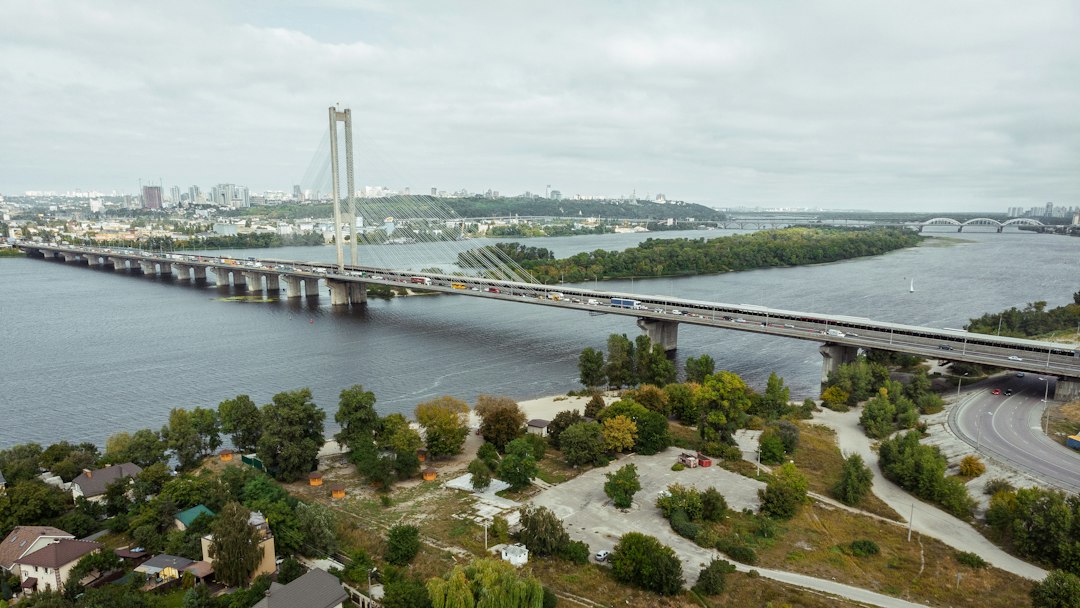
For much of the war, Kyiv’s bridges were arteries that residents could still largely count on. This week, that assumption began to break.
Russian aerial attacks have repeatedly hit crossings over the Dnipro River, forcing full or partial closures, producing long traffic jams and separating parts of a capital whose daily life depends on a small number of road links. On Saturday, October 3, a strike damaged the Northern Bridge after attacks the previous day disrupted three of Kyiv’s six road bridges, according to The Associated Press.
Russia’s Defense Ministry acknowledged the latest attack and said the bridge supported Ukrainian troop movements and military logistics. Ukrainian officials describe a wider campaign intended to disrupt civilian life and economic activity. Those competing accounts matter because a bridge can serve both civilian and military traffic. They do not, however, erase the immediate reality for residents: repeated strikes on a handful of crossings can make an entire city harder to move through without destroying any one bridge outright.
Why Kyiv’s bridges matter so much
The Dnipro is not a narrow urban waterway. It divides Kyiv into large eastern and western sections, and millions of journeys depend on the limited crossings between them. Homes, workplaces, hospitals, schools, rail connections and emergency services are distributed across both banks.
A bridge closure therefore causes consequences far beyond the damaged section. Traffic is pushed onto the remaining routes. Buses are delayed. Ambulances and other emergency vehicles may need longer alternatives. Workers can lose hours in transit, while businesses face delivery problems and higher costs.
Reuters reported that Russia struck a bridge linking the two sides of Kyiv for a second consecutive day on Friday, describing the attacks as part of an intensifying infrastructure campaign that was upending daily life. Before that attack, Mayor Vitali Klitschko had convened the city’s security council and called conditions in the capital “very dramatic,” according to the Reuters report republished by Investing.com.
A strategy of disruption, not only destruction
Large bridges are difficult targets. They are built to carry enormous loads, and superficial damage can often be repaired. But an attacker does not have to collapse a span to create a strategic effect. Repeated strikes can compel authorities to close lanes for inspection, restrict heavy vehicles, deploy air defenses around crossings and divert repair crews from other urgent work.
That makes uncertainty part of the weapon. Every new impact raises questions about structural safety, even when the visible damage appears limited. Officials must decide whether reopening a route is worth the risk of another strike or hidden damage.
The Institute for the Study of War assessed that repeated attacks on the Southern Bridge were part of a wider campaign to damage Ukraine’s economy and interfere with daily civilian activity. Its October 1 assessment also noted that modified drones may allow more precise attacks against hardened structures, although repeated hits would probably be needed to cause lasting disruption. That is an analytical judgment, not an independently established account of Russian intent.
The legal question is more complicated than the map
International humanitarian law does not automatically protect a bridge from attack simply because civilians use it. A normally civilian object can become a military objective if, under the circumstances at the time, it makes an effective contribution to military action and its destruction or neutralization offers a definite military advantage.
But that is not the end of the analysis. Parties must still distinguish military objectives from civilian objects, take feasible precautions and avoid attacks expected to cause civilian harm excessive in relation to the anticipated military advantage. Russia’s assertion that military traffic used a bridge does not by itself settle whether each attack complied with those rules. Nor does civilian disruption alone prove that a particular strike was unlawful. A credible legal assessment would require operational evidence that is not publicly available.
The wider context remains serious. In a July report covering December 2025 through May 2026, the United Nations Human Rights Monitoring Mission in Ukraine said Russian forces had systematically and repeatedly attacked energy facilities and that those attacks appeared to violate fundamental principles governing hostilities. The UN report does not make a finding about this week’s bridge strikes, but it documents the established pattern against which the new campaign is being examined.
The pressure falls unevenly
Traffic chaos can sound like an inconvenience compared with casualties at the front. In a city under sustained attack, it can become a public-safety problem. People with flexible jobs can work from home; hospital employees, factory workers, carers and service staff often cannot. Families with children may have no practical substitute for a closed route. Older residents and people with disabilities are least able to absorb long detours or sudden transport changes.
Kyiv has adapted its bridge operations throughout the war. The city has changed traffic rules during air alerts and reserved portions of newer crossings for buses, emergency services and special vehicles. An official Kyiv city guide notes that the Podilskyi Bridge was initially opened for special vehicles, emergency units and city buses, illustrating how tightly the crossings are integrated into essential services.
What Russia may be testing
The bridge campaign may test three things at once: whether Ukraine can protect large fixed structures, how quickly municipal crews can inspect and repair them, and how much repeated disruption the capital can absorb.
It may also force difficult air-defense choices. A city cannot place its most capable interceptors beside every bridge, power facility, railway junction and residential district. Cheap one-way drones can impose expensive defensive requirements even when they fail to destroy their target.
Ukraine, for its part, has attacked Russian oil refineries, military factories and transport infrastructure, arguing that these targets sustain Moscow’s war effort. Each side’s campaign is different in scale and circumstance, but both demonstrate how long-range drones have expanded the geography of the war and blurred the distance between front-line operations and economic pressure.
What to watch next
The most important immediate indicator will be whether the attacks remain intermittent or become a sustained effort against the same structural points. Repeated precision strikes in a short period would be more likely to overwhelm repairs and keep lanes closed.
Authorities will also be watching for attacks on rail bridges, power connections and the approaches that feed the crossings. Even an intact bridge is of limited use if access roads, substations or signaling systems are disabled.
Finally, the human effect will be measured not only in damage photographs but in travel times, missed medical appointments, interrupted schooling and emergency-response delays. The strategic significance of Kyiv’s bridges is precisely that they are both infrastructure and daily life.
For residents, the message of this week’s attacks is unsettling: the war is no longer only reaching Kyiv through explosions at isolated sites. It is increasingly targeting the connections that allow the city to function as one place.